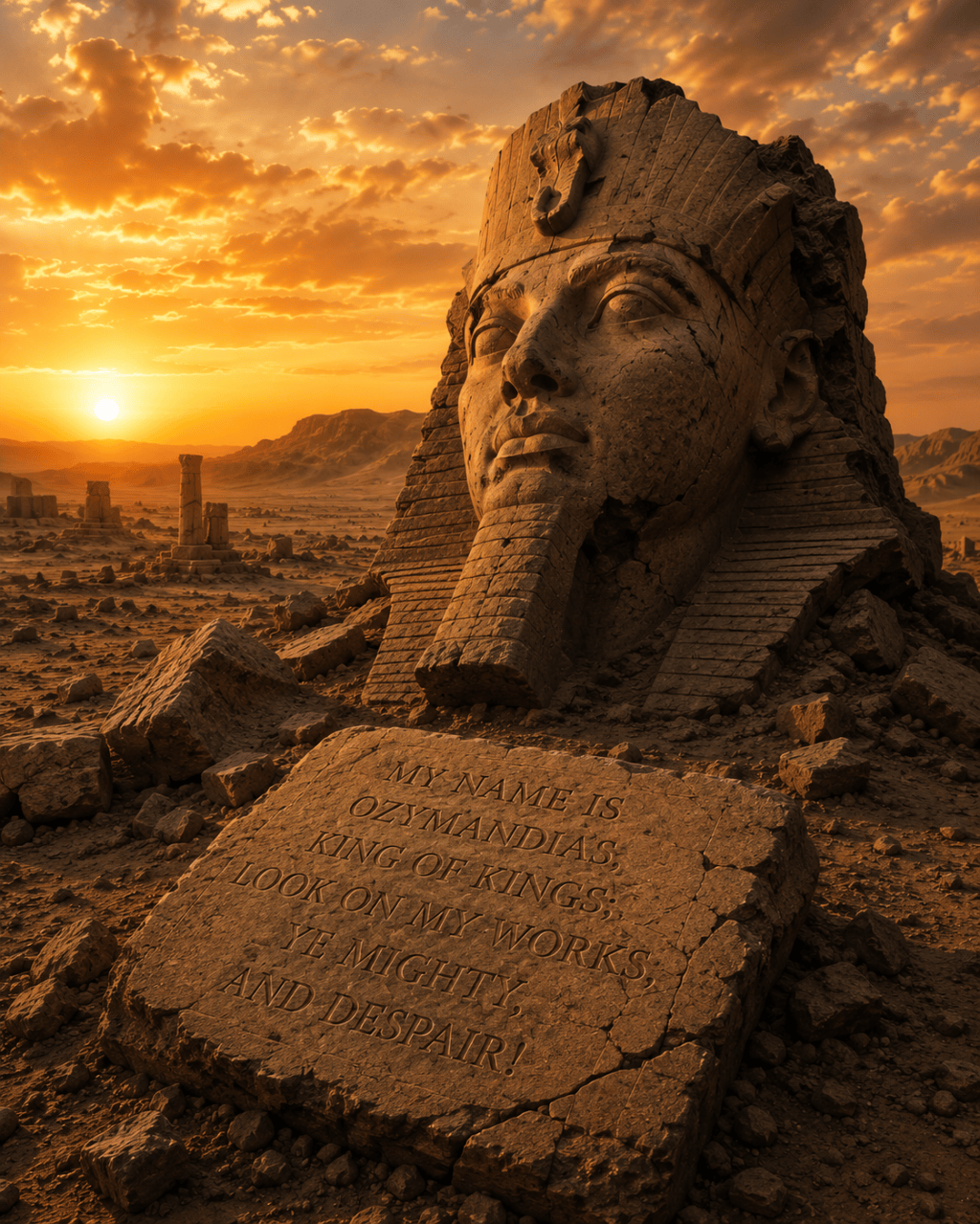
An exploration of power, pride, and the quiet triumph of time.
I have always loved my English classes. From school to college, some of my favourite mentors have been my English teachers. There has always been something fascinating about literature—the way a few lines can capture profound truths about life. Because of that, I found myself paying attention in almost every English class I attended.
During my first year of college, our English classes were divided into different groups for the second semester based on our performance in the previous semester. I was assigned to the English Through Literature class, and it quickly became one of my favourites.
I’ve always enjoyed stories, especially those that leave you thinking long after you’ve finished reading them. The stories and poems I remember most are not necessarily the most complicated ones, but the ones that quietly reveal something true about life.
One such poem was Ozymandias by Percy Bysshe Shelley.
Although it is only fourteen lines long—a sonnet, a poetic form traditionally associated with love—Shelley uses it to explore something entirely different: the impermanence of power, pride, and human achievement. It is remarkable how such a short poem can leave such a lasting impression.
The lines that have always stayed with me are:
“My name is Ozymandias, King of Kings;
Look on my Works, ye Mighty, and despair!”
In the poem, a traveller recounts discovering the ruins of a once-magnificent statue standing alone in the middle of a vast desert. The proud inscription still remains, boldly proclaiming the greatness of a king who believed his legacy would last forever. Yet surrounding those triumphant words is nothing but emptiness. The empire has disappeared. The monuments have crumbled. Time has erased everything except a broken statue and an ironic inscription.
Shelley drew inspiration from the Egyptian pharaoh Ramesses II, whose Greek name was Ozymandias. Ancient Greek historian Diodorus Siculus recorded an inscription associated with Ramesses II that has been translated roughly as:
“King of Kings am I, Osymandias. If anyone would know how great I am and where I lie, let him surpass one of my works.”
Shelley transformed that historical inscription into one of the most memorable lines in English literature. Those exact words were never literally carved on a monument; they were Shelley’s creative reimagining of an ancient inscription. Yet they perfectly capture the irony he wanted readers to see: the king who sought eternal glory is now remembered only through ruins swallowed by the desert.
I have always loved this poem because, despite its simplicity, the lesson it teaches is incredibly profound.
As I reflected on it, I couldn’t help but notice how closely its message echoes what the Bible has been teaching all along.
The Bible repeatedly reminds us that human life is fragile and fleeting. Psalm 103:15–16 compares our lives to grass and flowers that bloom for a short season before withering away. We spend years building our careers, our reputations, and our achievements, yet time eventually overtakes every one of them.
This same truth appears again in Isaiah 40:6–8, where all human glory is compared to the flowers of the field. They bloom beautifully for a moment, but they inevitably fade, while the Word of God alone endures forever. Shelley’s ruined monument becomes a powerful illustration of this biblical truth. Human glory fades; God’s truth does not.
The poem also made me think about how easily we place our identity in things that cannot follow us beyond this life. Psalm 49:16–17 reminds us not to be overwhelmed by the wealth or success of others because none of it accompanies us into eternity. Every possession, every title, every accomplishment remains behind.
Perhaps no biblical book expresses this reality more honestly than Ecclesiastes, with its repeated declaration, “Vanity of vanities; all is vanity.” Achievements that are pursued apart from God ultimately leave us empty because they were never meant to be our greatest purpose.
Likewise, Psalm 127:1 reminds us that “Unless the Lord builds the house, the builders labor in vain.” Human effort is not meaningless, but its lasting value depends on whether it is built upon God’s will rather than human pride.
The rise and fall of kingdoms is another recurring theme throughout Scripture. In the book of Daniel, King Nebuchadnezzar’s dream reveals a succession of mighty empires represented by gold, silver, bronze, and iron. Yet every earthly kingdom is eventually crushed by a stone not cut by human hands—a symbol of God’s eternal kingdom. History repeatedly confirms what both Daniel and Shelley portray: no empire, however powerful, lasts forever.
James asks a question that is impossible to ignore: “What is your life? You are a mist that appears for a little while and then vanishes.” (James 4:14). Our lives are brief, and tomorrow is never guaranteed. From the very beginning, Genesis 3:19 reminds humanity, “For dust you are and to dust you will return.” We often live as though we are permanent, but Scripture gently reminds us that we are not.
Yet the Bible does not leave us in despair. It shifts our focus from what fades to what lasts.
In 1 Corinthians 3:12–13, Paul teaches that every person’s work will be tested, and only what has been built upon Christ will endure. 2 Corinthians 4:18 encourages believers to fix their eyes not on what is seen, but on what is unseen, “for what is seen is temporary, but what is unseen is eternal.”
This is where the contrast between Ozymandias and Christ becomes especially striking.
Ozymandias called himself the “King of Kings,” believing his greatness would stand forever. But his kingdom disappeared, leaving behind only fragments of stone and fading memories. Jesus Christ, however, is the true King of kings (Revelation 19:16). His kingdom is not threatened by time, history, or death. Earthly rulers rise and fall, but Christ reigns forever.
Ultimately, Ozymandias is not a poem that discourages ambition or achievement. Rather, it warns us against believing that human greatness can outlast time. The Bible takes that lesson even further. It reminds us that while everything built solely for earthly glory will eventually fade, a life rooted in God carries eternal significance.
Perhaps the question is not, “What monument will I leave behind?” but rather, “Am I building a life that points to God’s eternal kingdom?”
Stone monuments weather. Reputations fade. Empires collapse. Wealth stays behind. We will not be judged by the amount we accumulated or the fame we achieved, but by the lives we lived before God and the fruit we bore for His kingdom.
In the end, human greatness is temporary, but God’s kingdom is eternal. And that is a legacy worth pursuing.
Image Credit: Chatgpt





 The Disenchanted Project
Leave a comment